Cloudy water on a Friday afternoon usually starts with one small number drifting out of range on Tuesday. That is why a solid pool chemical balance guide matters more than most owners expect. Water chemistry is not just about appearance – it affects swimmer safety, equipment life, sanitizer performance, and the day-to-day cost of running the pool.
For homeowners, communities, and hospitality properties, the goal is not to chase perfect test-strip colors. The goal is stable water. Stable water is easier to sanitize, gentler on surfaces and equipment, and far less likely to produce emergency callouts when usage spikes or temperatures rise.
What a pool chemical balance guide should actually help you control
Good pool chemistry sits on a few connected measurements. If one moves, the others often react. That is why treating chlorine alone rarely solves the real issue.
Start with pH. This measures how acidic or basic the water is. If pH is too high, chlorine becomes less effective and scale becomes more likely. If it drops too low, the water can become aggressive, irritating skin and eyes while also attacking metal components, grout, seals, and finishes.
Then comes total alkalinity. Think of alkalinity as the stabilizer for pH. When alkalinity is too low, pH tends to swing quickly. When it is too high, pH becomes difficult to adjust and scale risk increases. Many recurring balance problems are really alkalinity problems wearing a pH disguise.
Chlorine is the sanitizer most pool owners watch first, and for good reason. It controls bacteria and organic contamination. But chlorine only works well when pH is in range. A pool can test with chlorine present and still sanitize poorly if the rest of the chemistry is off.
Calcium hardness matters too, especially for plaster, tile, grout, and equipment. Water with very low calcium can become corrosive. Water with high calcium, especially combined with high pH and high temperature, tends to leave scale on surfaces, salt cells, and heat exchangers.
If the pool uses stabilized chlorine or gets strong sun exposure, cyanuric acid also needs monitoring. Too little and chlorine burns off too quickly. Too much and sanitizer efficiency drops, which can leave the water looking acceptable while protection declines.
Recommended pool chemistry ranges
A practical operating range for most residential and commercial pools looks like this:
- pH: 7.2 to 7.6
- Total alkalinity: 80 to 120 ppm
- Free chlorine: 1 to 3 ppm for many pools, sometimes higher depending on use and local requirements
- Calcium hardness: typically 200 to 400 ppm, depending on surface type
- Cyanuric acid: often 30 to 50 ppm for outdoor pools, though the right level depends on sanitizer method and sun exposure
These are useful benchmarks, not rigid rules for every installation. A hotel pool with heavy bather load, a private villa pool with intermittent use, and a community pool in peak summer do not behave the same way. Surface finish, heating, water source, and automatic dosing all influence where the water is easiest to maintain.
How to test and adjust without creating bigger problems
The most common mistake is adjusting everything at once. If chlorine is low, pH is high, and alkalinity is off, adding multiple products in one session often makes diagnosis harder. Correct pool chemistry works best in sequence.
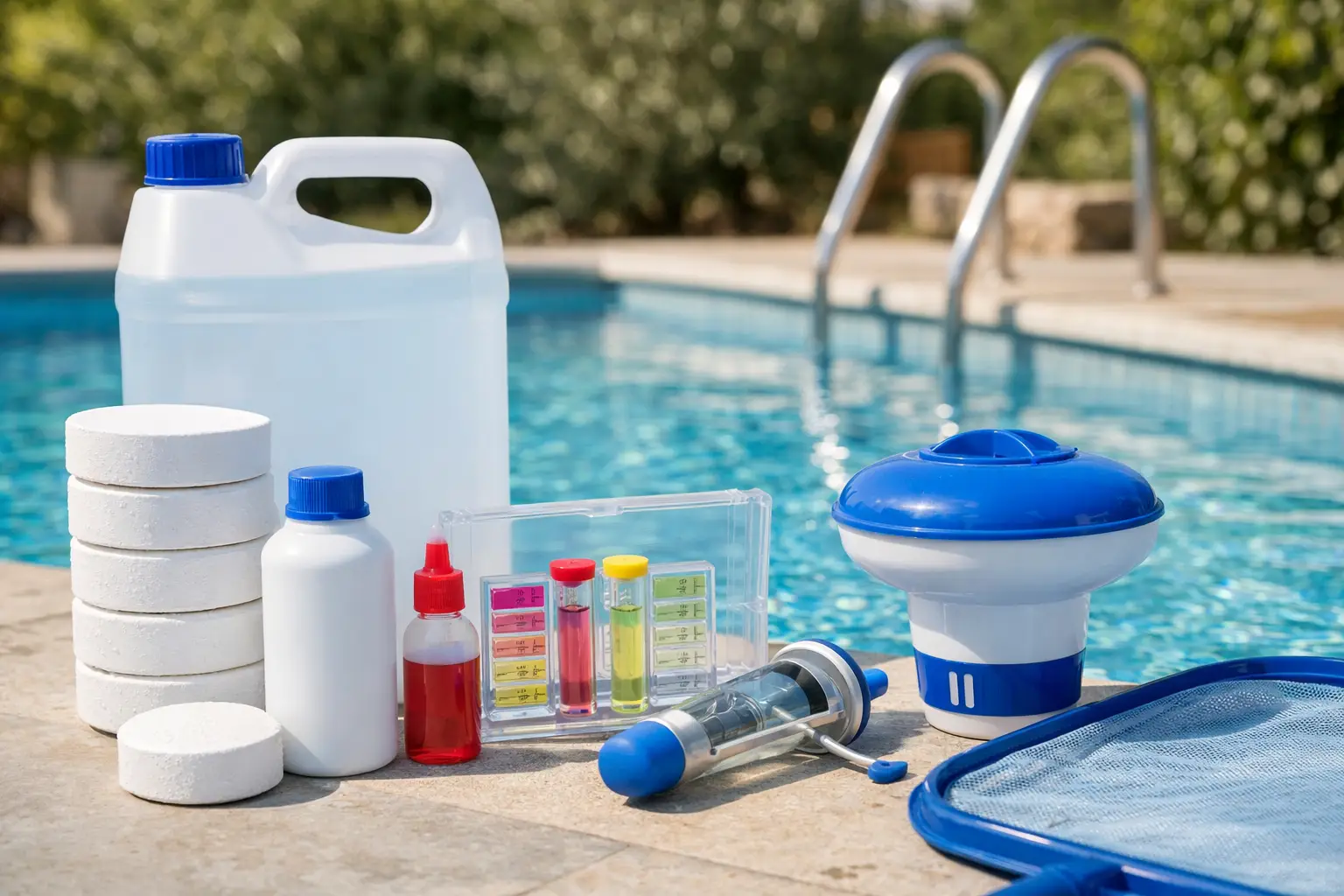
Test the water with a reliable kit. Digital readers and professional test kits are usually more dependable than basic strips, especially when readings are close to the edge. Record the numbers before adding anything. That simple habit makes it easier to spot recurring patterns, such as pH drifting up every week or chlorine dropping after high usage.
Start with total alkalinity if it is clearly out of range. Because alkalinity influences pH stability, correcting it first helps later changes hold. Then adjust pH. Once pH is in range, evaluate chlorine again. You may find the sanitizer performs better without needing as much product.
Calcium hardness and cyanuric acid should be corrected more carefully because they can be slower and more expensive to manage, and in some cases partial water replacement may be the best solution. This is one of those areas where rushing costs more than it saves.
Always allow circulation time between treatments. Chemicals need time to distribute through the system before retesting. Fast repeat dosing based on incomplete mixing is a common reason pools overshoot the target.
Why pool chemistry gets out of balance so often
In warm, sunny climates, water chemistry moves faster. Heat, evaporation, and UV exposure all push the pool harder. Add high swimmer load, sunscreen, leaves, dust, or irregular filtration, and even a well-maintained pool can shift quickly.
Rain creates a different set of problems. A storm can dilute sanitizer, alter pH, and introduce contaminants in a matter of hours. Topping off with fresh water also changes the balance, particularly if the local supply has high mineral content.
Equipment issues can quietly trigger chemical problems too. A clogged filter, poor circulation, an underperforming dosing system, or an aging salt cell can make the chemistry look inconsistent when the real problem is mechanical. That is why persistent imbalance should never be treated as a chemical-only issue.
Signs your water is balanced on paper but not in practice
Sometimes the test results appear acceptable, but the pool still tells a different story. Cloudiness, strong chlorine odor, scale at the waterline, staining, eye irritation, or slippery walls all point to underlying imbalance or insufficient circulation.
A strong chlorine smell does not usually mean the pool is extra clean. More often, it suggests chloramines or poor oxidation. In that situation, simply adding more routine chlorine may not solve the problem. The right response depends on the full reading, bather load, and whether the pool has enough turnover and filtration.
Scale on tile or equipment is another warning sign. It often reflects a combination of high pH, elevated calcium, and temperature-related concentration. Left unchecked, scale reduces efficiency and shortens equipment life.
A practical maintenance rhythm that prevents chemistry swings
Most pools benefit from a consistent testing schedule rather than reactive treatment. In moderate use, checking key levels two to three times per week is often enough. In peak season, after storms, during heavy occupancy, or in heated pools, daily checks may be more appropriate.
Brushing, skimming, and cleaning baskets also support chemical balance. Organic debris consumes sanitizer. Poor surface cleaning allows algae and biofilm to gain a foothold, and once that happens, chemical demand rises fast.
Filtration time matters as much as product choice. If circulation is too short, chemicals will not distribute properly and dead spots can develop. On the other hand, running equipment longer than necessary can raise operating costs if the system is not optimized. The right schedule depends on pool size, hydraulic design, bather load, and season.
For larger properties or owners who are not on site regularly, a structured maintenance plan often delivers better results than occasional corrections. That is especially true in markets with second homes, holiday rentals, and hospitality properties, where water quality has to stay reliable even when usage changes week to week.
When to call a professional instead of adding more product
If you are correcting the same issue every week, the pool is telling you something. Repeated pH drift, chlorine that never holds, recurring cloudiness, or constant scale buildup usually means the root cause has not been addressed.
Professional support becomes particularly useful when chemical imbalance is tied to equipment faults, leaks, poor circulation, or incorrect dosing setup. In those cases, buying more chemicals can mask symptoms while the real cost keeps building in the background.
For properties in high-demand areas such as Marbella, Mijas Costa, and Estepona, where heat, sun, and occupancy can put extra pressure on water quality, regular technical oversight reduces risk and protects the asset. Infinity Brand approaches this with clear diagnostics, scheduled care, and corrections based on the full system, not just the latest test result.
The most useful takeaway from any pool chemical balance guide
Balanced water is not about hitting a perfect number once. It is about keeping the pool predictable. When chemistry is stable, sanitation improves, surfaces last longer, equipment works more efficiently, and the pool stays ready to use without constant intervention.
That is the difference between managing a pool and controlling it. If your water has become hard to keep clear, step back, test methodically, and correct the cause instead of chasing the symptom. Your pool will usually reward that discipline faster than any quick fix.